Earth Land – View per individual
Earth Land – View per individual

Background Insights on Resource & Societal System
Grasping the size and complexity of Earth's surface is challenging from a human-scale viewpoint. This makes decision-making around land use — whether individual or collective — a difficult task.
This article breaks down how land is distributed and used globally, using a simple reference point: land per person, assuming a world population of 10 billion people. This gives a human-scale view using ares (1 are = 100 m²) — about the size of a small house footprint.
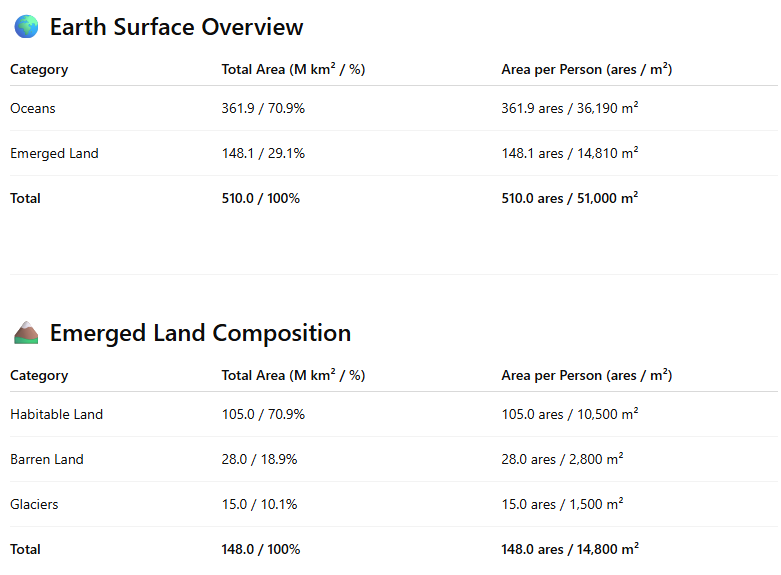
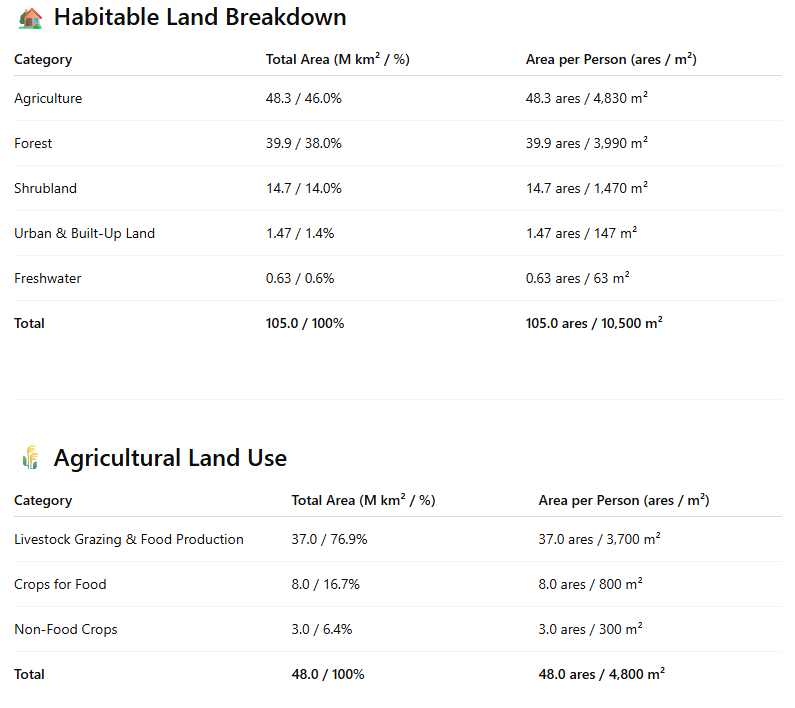
While livestock use dominates agricultural land (77%), it contributes only 18% of global calories and 37% of protein, according toUN FAO data.
If everyone adopted aplant-based diet:
Only15 ares (1,500 m²)of land per person would be needed for crops
This would free up~31 ares (3,100 m²)per person
Globally, that’s31 million km²— potentially restorable to forests or used for clean energy
km² = 1,000,000 m²
1 M km² = 1 million km² = 1,000 billion m²
1 hectare (ha) = 100 ares = 10,000 m²
1 are (a) = 100 m² ≈ footprint of a typical house